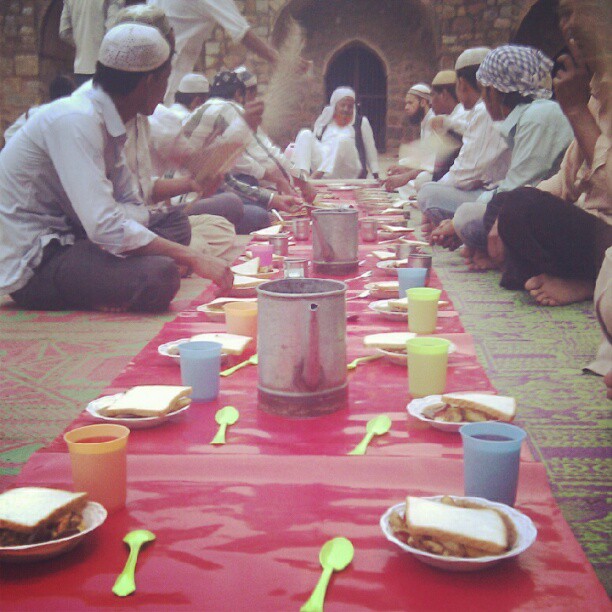

“Roza rakhne ki himmat dene wala toh Allah hai.”
(It’s Allah who gives us the courage to fast.)
The auto driver didn’t see much reason for my fascination with his observance of fast. Not that I don’t know people who fast while maintaining their daily affairs and seeking of livelihood in the same matter-of-fact manner as they do through the rest of the year. All of us do. But each time I come across someone fasting who does manual labor for a living, a feeling of slight awe always takes over me. (An auto driver may not technically not fit the description of manual labor, but I believe you get the idea. I’ve known rickshaw pullers and construction laborers who’ve fasted through the day while working too. The word respect sounds constrained in meaning at such times.)
I had noticed him at the spread for Iftar a while ago, in a similar manner that I had noticed similar looking faces of men who had stopped by at this mosque on the way back from (or on their way to) work. The mosque was a discovery. Returning back from a meeting at Connaught Place, my original plan was to get inside Old Fort and spend some time at the mosque in there. It turned out that the administration stopped entry around sunset. Slightly disappointed, I started walking towards the mosque at the Matka Peer tomb near Pragati Maidan.
One of the most beautiful magical tricks of Delhi is the way it will make something emerge out of the folds of its history. You would have crossed by that something a gazillion times not noticing it in the rush which this city addicts you with. But in that moment when you need it and will truly appreciate the beauty and presence of that something, Delhi will make it emerge in front of you.
Across the road from the Old Fort is another set of ruins, which are constructed in the Mughal style of architecture. Since I was walking, I realized the structure looked like a mosque, which wasn’t exactly a revelatory moment: ruins of mosques are spread across most of Central and South Delhi with an abundance. It may not be far fetched to believe that most Delhiites look at such ruins in the same vein that they look at traffic lights: they will cross them everyday, stop by them for a while too, but never care for why they might be there.
The moment of revelation for me was when I crossed the open gate of the mosque and saw a group of around 30 men setting up a dastarkhwan for Iftar in the wide open courtyard of the mosque. Never had I imagined it to be a mosque which would be functional, let alone serving Iftar. Constructed by the wet nurse of the Mughal emperor Akbar, the ruins of the central structure still bore signs of the majesty it would have held in its sway a few centuries ago. Nostalgia struck me from the days of childhood spent in my ancestral village as buckets were being thrown down into the well (yes, functional) to fill water into bidets for wudhu.
Quickly settling in along side everybody else, an elderly gentleman with long hair and a flowing henna-ed beard (I discovered in a few minutes that he was the muezzin), noticing me as the new face, asked me affectionately about how I found my way to the mosque. On hearing the lowdown from me, he had a warm smile as he said:
“Aapka rizq aapko aaj yahaan lekar aaya hai.”
(The provisions of your fate have brought you here today.)