After yesterday (and the splitting headache which accompanied the wait till Suhoor), I had made up my mind that I’m definitely not going to adhere to the philosophy of eating light at Iftar. Plus in a way, Ramadan had ‘officially’ not kicked in for me yet.
There is a fairly popular anecdote in the region I grew up. A Muslim gentleman was once asked during Ramadan:
Bhai, Namaz to padhte hain na aap? (Brother, I hope you offer Namaz?)
Ji, agar kabhi mauqa hua to Juma padh leta hoon. (If I rarely can, its the Friday prayers)
Accha bhai, Rozay to rakhte hi honge? (Then brother, I’m sure you must be fasting during Ramadan?)
Arey nahi bhai, Rozay bade bhaari pad jaate hain, din bhar kaam bhi karna hota hai. (Oh no, fasting becomes a bit tough for me, with working through the day and all)
Toh bhai, Nihari bhi nahi khaate kya? (So brother, you don’t eat Nihari either?)
Arey kya ekdum kaafir hi samajh liya hai kya? (What! Do you really think I’m a complete non-believer?)
So yes, that’s what Nihari means for those who attach the much deserved significance of faith to it. And Ramadan has always been that month when Nihari makes an appearance like none other when it comes to satiating a tummy which has been gurgling empty all day. Even making for an excellent start to a day long fast for that matter at Suhoor, though purists would say that Paaya makes for a better meal in the wee hours of the morning.
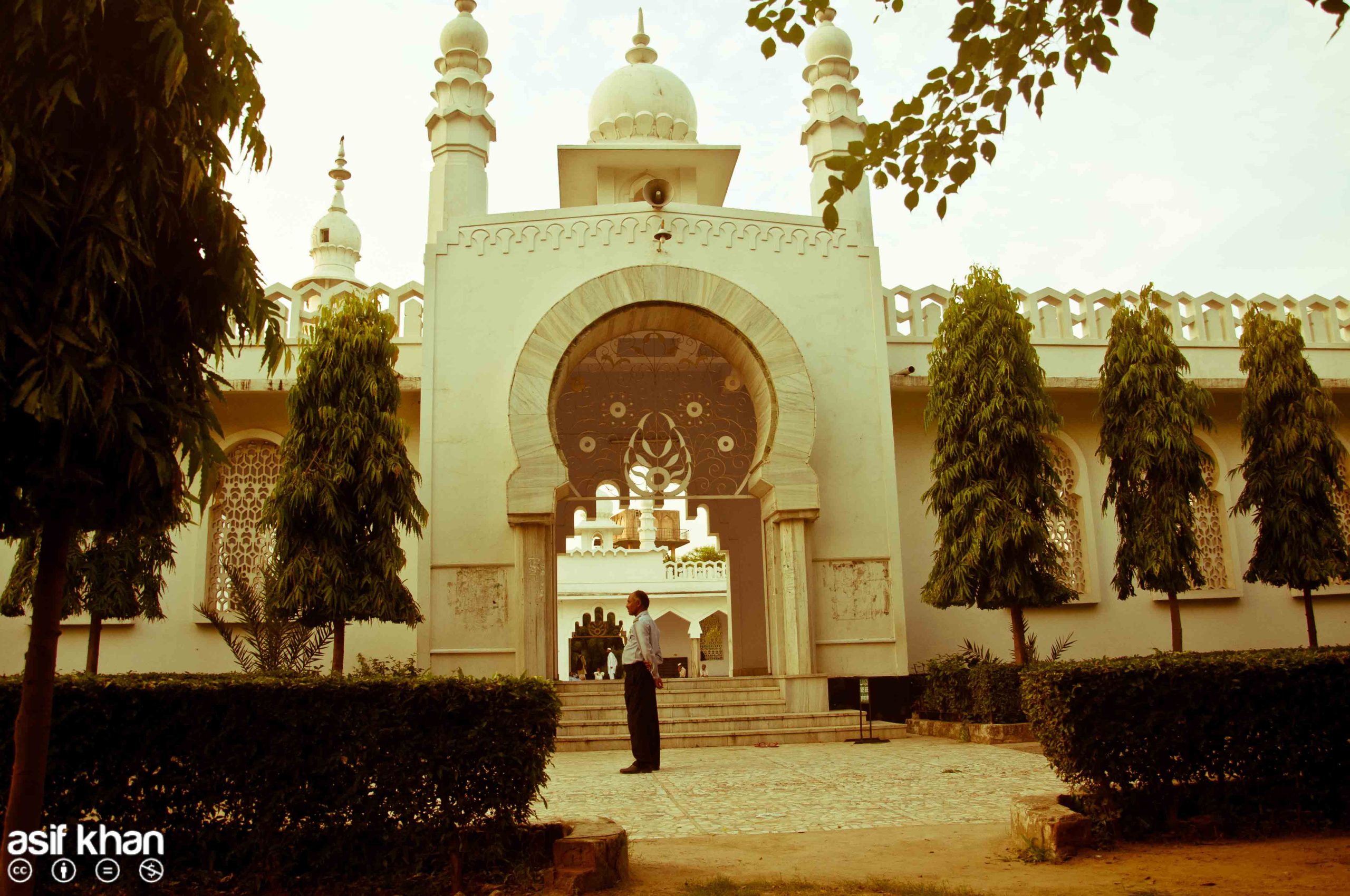
The original plan for today’s mosque was therefore postponed to a later date in the week, and on an impromptu note, the site shifted to the Jamia University campus. Jamia Millia Islamia happens to be situated on the boundaries of what most people recognize as a Muslim ghetto. Despite whatever aspersions might be cast on ghettos from a social standpoint, they are a nice place. Specially nice for people who might have migrated recently to a big city, and happen to form part of a socio-religious class which doesn’t allow them to fetch accommodation in neighborhoods which have a certain aspirational tag attached to them. Yes, I’ve spent my years there too when I first came out of college, fresh into a job in the capital city, being part of flats giving shelter to like 6-10 college passouts looking for jobs, but then eventually all of us did fare decently well. And those ‘other’ neighborhoods didn’t remain much of an ‘aspiration’ after some point either. They just became a reality.
[slideshow]
The Jamia University campus mosque occupies a special place for me too. In some ways, it has always reminded me of the central mosque at my Alma Mater (Aligarh Muslim University, and we do have a grand mosque steeped in a lot of history), and though JMI doesn’t really boast of a heritage as old or a grandeur as opulent as AMU, it still occupies a pride of place for being one of the leading institutes of higher education. Or at least, it was established with that objective in the mind of its founding fathers. Enter the mosque, and you get the feeling of a campus mosque with a large open courtyard in the center, with a huge hall in the front fairly well occupied during prayer hours most of the time through the year, at least from whatever I’ve seen in my visits over the years. Ramadan of course is different. The Iftar was held in the open courtyard with roughly 50 people in two files, mostly comprising University employees, some students and some residents of the neighborhood. Breaking the fast under the open sky in a spacious courtyard brings on a certain feeling of unity with the surrounding elements. (Thinking of which makes me look forward to visiting other mosques which have much bigger courtyards).
Ghettos are nice. Due to the concentration of a middle class working population and a combination of similar social factors, they happen to perfect recipes handed down over generations to near perfection. Not really a phenomenon unique to the areas surrounding just Jamia, I’m sure any ghetto across the world has similar stories. And there are quite a few places which dish out some really good Nihari through the year. One place which has caught my fancy in the past few months is this place, quite unimaginatively called, Madina Restaurant, and my guess has always been this place has had something to do with the similarly named place in Ballimaran (Old Delhi), because it serves Purani Dilli style Nihari too (yes, every area has its own way of stewing them hooves overnight). A quick dash after Iftar, piping hot naans from the tandoor, and Nihari floating in melted butter (strictly never the other way round), and there couldn’t have been a better way to welcome Ramadan.
Ramadan had begun for me now. It was official.